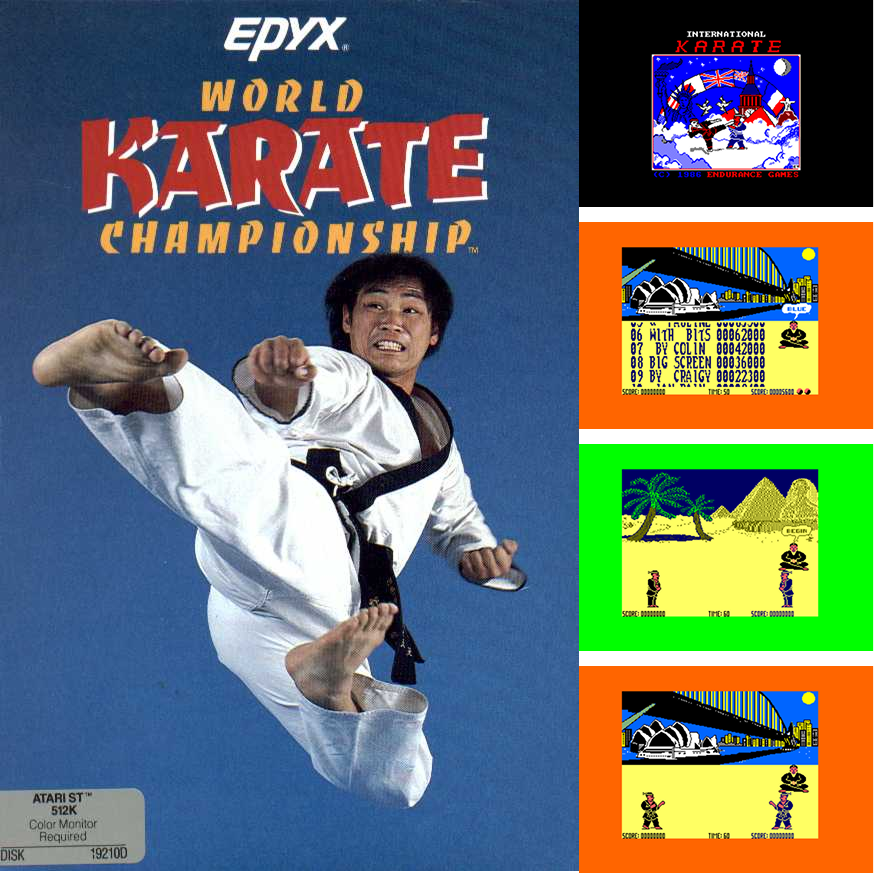
World Karate Championship from 1986, known outside the U.S. as International Karate, is a one-on-one martial arts fighting game where players strive to earn higher belt rankings by defeating a series of opponents across international backdrops like Egypt, New York, and Japan. Between matches, bonus stages add variety with challenges such as breaking boards or deflecting projectiles for extra points.
Developed by System 3 and published by Epyx in North America, it became the first European-developed game to top the U.S. charts, ultimately selling over 1.5 million copies. However, its success also sparked one of the most important legal battles in video game history. In Data East USA, Inc. v. Epyx, Inc., Epyx was accused of copying the arcade hit Karate Champ. Although a lower court initially ruled against Epyx, the decision was overturned on appeal in 1988. The Ninth Circuit determined that no company could monopolize the concept of a karate sport simulation, a precedent-setting decision that continues to influence copyright law in gaming today.
Despite the controversy, World Karate Championship was praised for its smooth controls, scenic visuals, and accessible yet satisfying gameplay, securing its place as a standout entry in the early fighting game genre.
Despite being a defendant in one of the most important legal battles in video game history, namely
Data East USA, Inc. v. Epyx, Inc., we don’t retain rights to this title. It’s a System 3 title known as International Karate.
System 3 is still around if you want to reach out to them for licensing information.
What’s really cool about this case (and taken from the link above) is how the court dissected what can and can not be protected. They found that “…the visual depiction of karate matches is subject to the
constraints inherent in the sport of karate itself. The
number of combatants, the
stance employed by the combatants, established and
recognized moves and motions regularly employed in the sport of karate, the
regulation of the match by at least one referee or judge, and the
manner of scoring by points and half points are among the constraints inherent in the sport of karate. Because of these constraints, karate is not susceptible of a wholly fanciful presentation. Furthermore, the use of the Commodore computer for a karate game intended for home consumption is subject to various constraints inherent in the use of that computer. Among the constraints are the use of sprites, and a somewhat limited access to color, together with limitations upon the use of multiple colors in one visual image.”
So there you have it. You can’t protect the representation of a sport if that’s the definition of the sport itself.