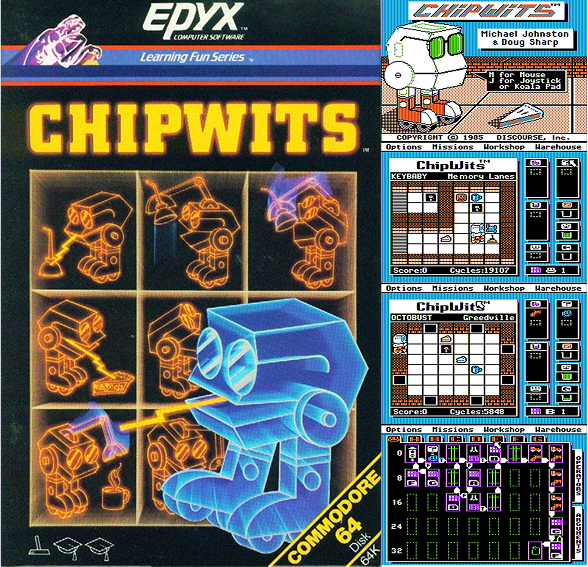
ChipWits (1985) is an early educational programming game that challenges players to design and optimize the behavior of a small robot navigating maze-like environments. Originally developed for the Macintosh in 1984 and later ported to the Commodore 64 and Apple II by Epyx, it introduced players—especially beginners and younger audiences—to logic and programming through visual, puzzle-based gameplay.
Players build their robot’s behavior by assembling “Chips,” each representing a simple instruction like look, move, or smell, with optional conditions and actions. These Chips are arranged in flowchart-like sequences, allowing the ChipWit to react to its environment and make decisions. Once deployed into a level, the robot acts autonomously, following its programmed logic to collect fuel, avoid hazards like Electro-Crabs and Bouncers, and gather items that maximize its score. Players cannot control the robot in real-time but can debug and tweak its behavior between runs.
Each level has a CPU cycle limit, encouraging players to refine their code for both effectiveness and efficiency. With real-time feedback and visual debugging tools, ChipWits helped demystify the logic behind programming long before “coding for kids” became a mainstream concept.
Though relatively simple by modern standards, ChipWits earned acclaim for its engaging and educational gameplay. It won several awards and is remembered as one of the Macintosh’s early standout titles—both for its creative concept and its lasting influence on educational software design.
There’s a special place in our heart for this title, as it was one of the earliest titles to help teach programming concepts. It was also written in Forth, a language that started to gain in popularity around 1980, peaked in 1985, and dropped out of the Top 10 in 1989. There’s a great visualization of Forth’s ascend to the 7th most popular programming language in 1985 at the
Data Is Beautiful YouTube channel, Epyx did the ports of this program from the original MacForth Plus code to the Commodore 64 using SuperForth 64. Epyx also ported it to the Apple II, but we’re not sure if it was FIG-Forth, ProForth, or a different Forth compiler.
Both of these ports were done under license, and the title remains the property of the original developers (Discourse, Inc.). There’s an absolutely fantastic write-up about trying to modernize the original Chipwits code titled
Back to 1984: Rebuilding ChipWits for the Macintosh 128K that is a great source, and you can rediscover and play Chipwits at
Chipwits.com.