Rogue (1980) is the foundational dungeon-crawling adventure that gave birth to an entire genre. The player assumes the role of an adventurer descending into the procedurally generated Dungeon of Doom to retrieve the Amulet of Yendor and return to the surface alive. Every session is unique, with layouts, items, and monster placements randomized at the start of each game.
The game is rendered entirely in ASCII characters: walls are dashes and pipes, monsters are represented by capital letters (e.g., ‘Z’ for zombie), and the player is denoted by an ‘@’ symbol. Gameplay is turn-based, and each level grows more dangerous the deeper the player descends. Twenty-six different monster types roam the halls, each with unique behaviors and difficulty levels. Players must manage limited food supplies, use scrolls and potions with unknown effects, and carefully decide when to fight or flee.
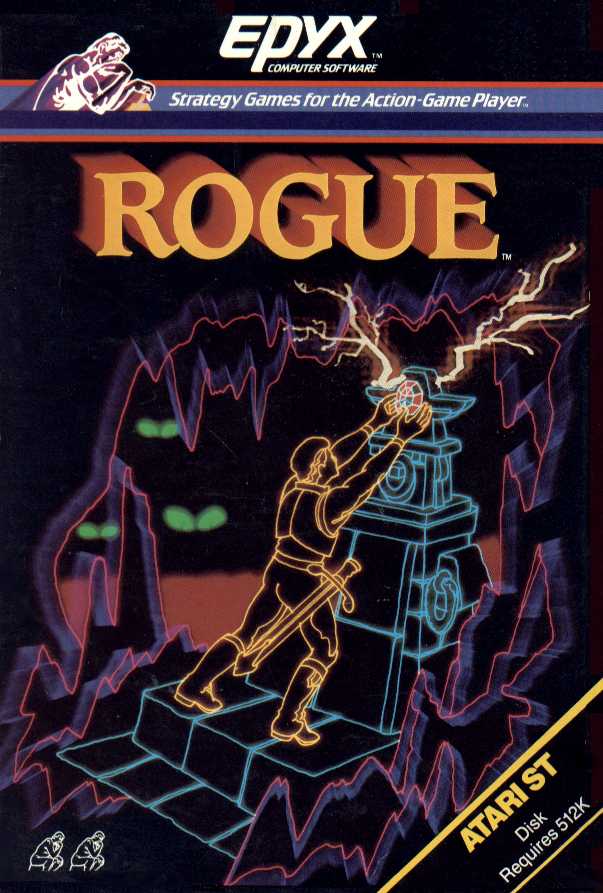
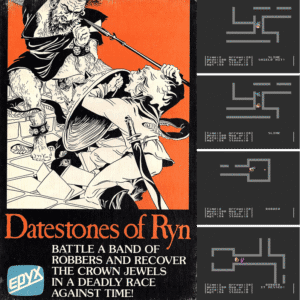
Notable for its harsh permadeath system, Rogue does not allow saving and reloading; death means starting over from scratch. The game’s control scheme was inspired by the vi text editor, and it quickly became a favorite on Unix systems and later received commercial ports to systems like the Commodore 64, DOS, and Apple II under Epyx’s banner.
Its legacy extends far beyond its initial release, influencing countless games and spawning the entire “roguelike” subgenre. Despite its minimal visuals, Rogue offers deep strategy, endless variety, and a compelling loop that still challenges players today.
Licensing for Rogue is a little complex. There is a core, open source, text-based game, and then there are the Epyx ports to various platforms that included greatly enhanced graphics and other effects. Those enhancements are copyrighted and are our intellectual property, as well as the coolest box cover ever to have existed for any piece of software, ever. If you want to help revive any of the Epyx-style ports, please reach out to us.